Showing posts with label Economy. Show all posts

Monday, January 26, 2015

SPY And The U.S. Economic Index In 2014: A Guide


“Mirrored by about a zillion data points of light in either AppleWorks or Microsoft Excel spreadsheets on multiple media here at the home office of my Risky Business, changes in the U.S. economy are reflected by changes in its equity market. And vice versa.” So began “You Got to Know When to Hold ’em,” my very first blog post published here back in 2011 on one of the most important methods I employ to assess the relationship between the American economy and the large-capitalization segment of the stock market.

Last year, our droogies at Seeking Alpha published almost a dozen of my articles focused on monthly studies of the relationship between the economy, as represented by the proprietary U.S. Economic Index, and the large-cap segment of the market, as represented by the nonproprietary SPDR S&P 500 ETF (SPY). Links to all the pieces in this series appear below in reverse chronological order.

This year, I plan to expand my coverage in a couple of ways. First, I will complement increasingly the objective facts with my subjective opinions as to their potential meaning in the context of the SPY-USEI relationship. And, second, I will examine the relationship between the economy and the small-cap segment of the market. All the resultant stories will be published at either J.J.’s Risky Business or Seeking Alpha.

I suspect the U.S. Federal Reserve’s actual announcement of the end of asset purchases under its latest quantitative-easing program Oct. 29 and its projected announcement of the beginning of federal-funds-rate hikes April 29 make monitoring of the continuous feedback loop between the economy and the market more significant now than it has been at any other time during the past three years.

SPY And The U.S. Economic Index In 2014: Linkfest


Tuesday, November 25, 2014

Risky Business Monitor: Nov. 24, 2014

The New York Stock Exchange most likely will publish this holiday-shortened week its data on securities market credit, which means I should soon be able to bring up-to-date the levels of my Margin Debt Directional Indicator, or MDDI, and my Securities Market Credit Risk Rank, or SMC Risk Rank, as well as the associated comparison of the historical monthly levels of NYSE margin debt and the SPDR S&P 500 ETF (SPY). The article based on these data will be published at either J.J.’s Risky Business or Seeking Alpha.

Meanwhile, Seeking Alpha will publish at least the first of the three data-intensive pieces about U.S. Federal Reserve policy to which I referred in the Risky Business Monitor last week.

Over the weekend, I briefly covered Russian President Vladimir Putin’s wide-ranging interview with the state-owned Tass news agency in a story titled “Russia Will Not Rebuild Iron Curtain In Wake Of Economic Sanctions Over Ukraine: Vladimir Putin” at the International Business Times Sunday. Given his country’s petroeconomy, he had plenty to say about the effects of those sanctions imposed by the European Union and the U.S., as well as the status of his nation’s energy sector.

Related Reading


Shameless Self-Promotion! If you like my work, then you can follow me as J.J. McGrath at Google+ and Seeking Alpha, as JJMcGrath at StockTwits and @JJMcGrath3000 at Twitter. If you do not like my work, then you can follow me at all those places, anyway.


Monday, November 17, 2014

Risky Business Monitor: Nov. 17, 2014

Billboarding a project in advance of its completion is a dangerous thing to do in the publishing game, but I anticipate producing three articles about U.S. Federal Reserve policy by this time next week. All these data-intensive pieces will be published at either J.J.’s Risky Business or Seeking Alpha.

Meanwhile, I briefly covered the Group of 20 leaders’ communiqué issued at the conclusion of their two-day summit in Brisbane, Australia, in “G-20 Aims To Boost Its GDP 2% By 2018” at the International Business Times Sunday. As noted in the story: “U.K. Prime Minister David Cameron at the summit pledged to put ‘rocket boosters’ behind a plan for [a European Union]-U.S. free-trade agreement, BBC News reported. Cameron said EU and U.S. leaders all agreed the Transatlantic Trade and Investment Partnership, or TTIP, ‘is a deal we want.’” An EU-U.S. free-trade agreement on rocket boosters: What could possibly go wrong?

Related Reading


Shameless Self-Promotion! If you like my work, then you can follow me as J.J. McGrath at Google+ and Seeking Alpha, as JJMcGrath at StockTwits and @JJMcGrath3000 at Twitter. If you do not like my work, then you can follow me at all those places, anyway.

Monday, November 10, 2014

Risky Business Monitor: Nov. 10, 2014


Between all the Asia-Pacific Economic Cooperation meetings this week and the Hong Kong-Shanghai exchange linkup next week, China appears to be at the center of the economic/market multiverse at this point in time. Accordingly, it is completely unsurprising I focused on the country’s prospects in my “China’s President Xi Jinping Signals Economic Growth Could Slow To 7% In APEC CEO Summit Speech” at the International Business Times Sunday.

I also was able to bring up-to-date my proprietary U.S. Economic Index and the associated comparison of the historical monthly levels of the USEI and the SPDR S&P 500 ETF (SPY). Following are links to all the articles in this series published at Seeking Alpha this year:


Related Reading


Shameless Self-Promotion! If you like my work, then you can follow me as J.J. McGrath at Google+ and Seeking Alpha, as JJMcGrath at StockTwits and @JJMcGrath3000 at Twitter. If you do not like my work, then you can follow me at all those places, anyway.

Monday, September 15, 2014

Risky Business Monitor: Sept. 15, 2014


Multivariate analyses indicate my proprietary U.S. Economic Index may have hit its peak for the year last month, especially given the anticipated end of asset purchases under the absolutely large U.S. Federal Reserve quantitative-easing program and the expected beginning of such purchases under the relatively small European Central Bank QE program.

As we await confirmation or nonconfirmation of this suggested peak circa Oct. 3, I note our droogies at Seeking Alpha have published this year the following pieces on the USEI and the associated comparisons of the historical monthly levels of the index and the SPDR S&P 500 ETF (SPY):


Related Reading


Shameless Self-Promotion! If you like my work, then you can follow me as J.J. McGrath at Google+ and Seeking Alpha, as JJMcGrath at StockTwits and @JJMcGrath3000 at Twitter. If you do not like my work, then you can follow me at all those places, anyway.

Tuesday, September 9, 2014

Risky Business Monitor: Sept. 8, 2014


Meteorites hit this planet all the time, but the ones making impacts are few and far between, which means the heavenly body that apparently struck the Nicaraguan capital of Managua Saturday seemed to be kind of a rare thing.

As I finalize the latest article about my proprietary U.S. Economic Index, I am seeing the European Central Bank’s move into quantitative easing Thursday in the same light. The USEI-centered analysis should be published at either J.J.’s Risky Business or Seeking Alpha within a day or two.

Meanwhile, I had a couple of news stories of interest published at the International Business Times since the Risky Business Monitor linkfest last week, as follows:


Related Reading


Shameless Self-Promotion! If you like my work, then you can follow me as J.J. McGrath at Google+ and Seeking Alpha, as JJMcGrath at StockTwits and @JJMcGrath3000 at Twitter. If you do not like my work, then you can follow me at all those places, anyway.

Monday, August 25, 2014

Risky Business Monitor: Aug. 25, 2014


Fedspeak is reverberating in my mind at this moment with Federal Reserve Chair Janet L. Yellen delivering a major speech at the Federal Reserve Bank of Kansas City Economic Symposium in Jackson Hole, Wyo., Friday and the Federal Open Market Committee releasing the minutes of its July 29-30 meeting Wednesday.

An interesting article on aspects of this Fedspeak appeared in the International Business Times Sunday. However, it was authored not by me but by Reuters: “Fed Should Lay Groundwork For Interest Rate Hikes: Officials.” Meanwhile, I anticipate publishing at least one piece on the U.S. economy-market relationship this week.

Related Reading


Shameless Self-Promotion! If you like my work, then you can follow me as J.J. McGrath at Google+ and Seeking Alpha, as JJMcGrath at StockTwits and @JJMcGrath3000 at Twitter. If you do not like my work, then you can follow me at all those places, anyway.

Monday, August 18, 2014

Risky Business Monitor: Aug. 18, 2014

Multivariate analyses indicate my proprietary U.S. Economic Index either may have hit its peak for 2014 last month or might hit its peak for the year this month. Therefore, I can’t wait for my next USEI-centered article, which will be published at J.J.’s Risky Business or Seeking Alpha circa Sept. 5. Meanwhile, our droogies at SA have published this year the following pieces on the USEI and the associated comparisons of the historical monthly levels of the index and the SPDR S&P 500 ETF (SPY):


Related Reading


Shameless Self-Promotion! If you like my work, then you can follow me as J.J. McGrath at Google+ and Seeking Alpha, as JJMcGrath at StockTwits and @JJMcGrath3000 at Twitter. If you do not like my work, then you can follow me at all those places, anyway.

Thursday, September 22, 2011

'Operation Twist I' and SPX Behavior

A half-century ago, the U.S. Department of the Treasury and Federal Reserve conducted "Operation Twist I" under economic conditions described well by Titan Alon and Eric Swanson last April 25 in their "Operation Twist and the Effect of Large-Scale Asset Purchases," which I mentioned in "Go, Chubby, Go: Let's Twist Again!" this week.

Yesterday, the Federal Open Market Committee (FOMC) announced "Operation Twist II" under economic conditions described well in an many places virtually every day, including this very blog (e.g., "GDP Slide Signals Recession. Soon.").

There are similarities and differences in the U.S. economic conditions existing during the two periods. One obvious similarity centers on the status of the business cycle, meaning the above-referenced R-word was or is on almost everybody's lips in both cases. One obvious difference centers on the country's debt as a percentage of gross domestic product, which was not too bad in 1961 but is not too good in 2011.

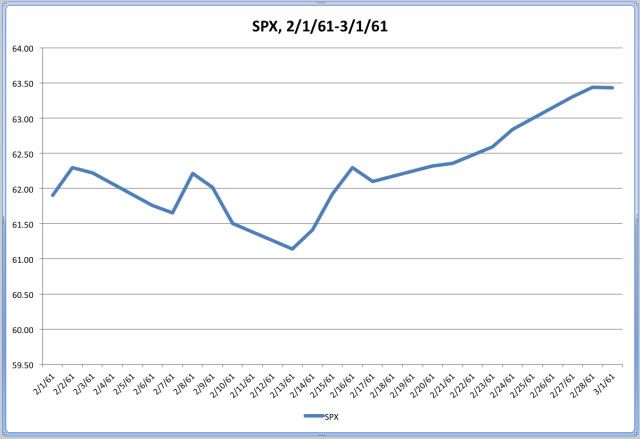
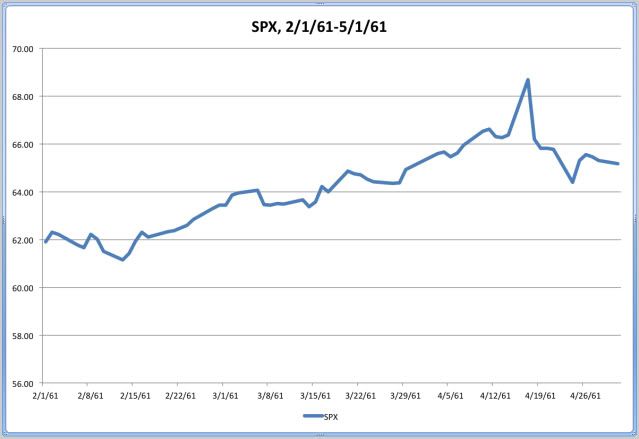
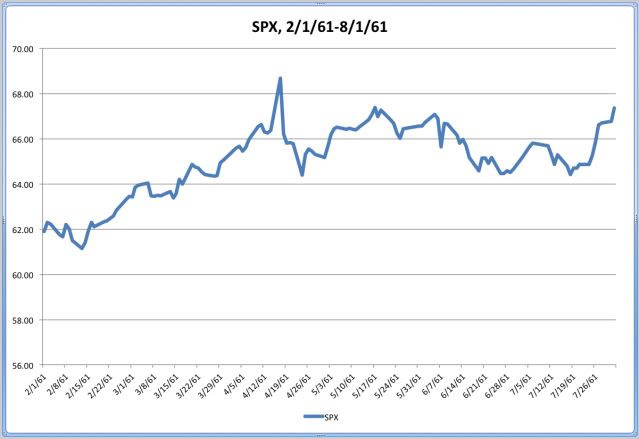
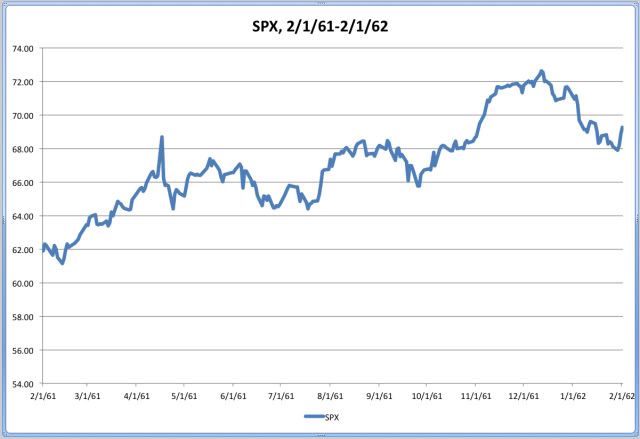
Given this mishmash, it may or may not be helpful to examine the market performance of the Standard & Poor's (S&P) 500 (SPX) in the wake of the launch of "Operation Twist I" on Feb. 2, 1961. But I did it, anyway.

With a common baseline of Feb. 1, 1961, the four charts below show the S&P 500's behavior during the following one-month, three-month, six-month, and one-year periods, respectively:


Source: Risky Business Charts Based on Yahoo! Finance Adjusted Closing-Price Data

If past is prologue, then the recent equity-market crash may be comparatively short-lived. After all, the Fed will be driving financial-market participants out of the long end and into the short end of the U.S. Treasury yield curve, as well as higher-risk assets.

If past is not prologue, then the recent stock-market crash may be relatively long-lived. Clearly, aggregate demand is lacking in the U.S., and nearly all available evidence indicates this circumstance is other than either a local or a temporary phenomenon.

You pays your money, and you takes your chances.

Wednesday, September 21, 2011

'Twist' Tops the Ops at the FOMC

In a well-choreographed move, the Federal Open Market Committee (FOMC) OK'd today by a 7-3 vote a new cover of "Operation Twist." The original version was discussed in "Go, Chubby, Go: Let's Twist Again!" on Monday.

According to the FOMC statement belatedly released at the conclusion of its two-day meeting: "[T]he committee decided today to extend the average maturity of its holdings of securities. The committee intends to purchase, by the end of June 2012, $400 billion of Treasury securities with remaining maturities of [six] years to 30 years and to sell an equal amount of Treasury securities with remaining maturities of [three] years or less. This program should put downward pressure on longer-term interest rates and help make broader financial conditions more accommodative. The committee will regularly review the size and composition of its securities holdings and is prepared to adjust those holdings as appropriate."

The FOMC also noted: "To help support conditions in mortgage markets, the committee will now reinvest principal payments from its holdings of agency debt and agency mortgage-backed securities in agency mortgage-backed securities. In addition, the committee will maintain its existing policy of rolling over maturing Treasury securities at auction."

All things considered, I believe this plan may have a limited effect on the U.S. economy, but I think its potential impact on the yield curve may constitute a headwind in terms of the profitability of certain financial institutions (e.g., banks).

Tuesday, September 20, 2011

You Say To-may-to, I Say To-mah-to

In "GDP Slide Signals Recession. Soon." on Sunday, I indicated my fact-based opinion is that the U.S. economy either has shifted or is shifting to contraction from expansion.

One key factor in the forming of this opinion is the anemic 1.55% change in real gross domestic product (GDP) recorded during the most recently reported four-quarter period (i.e., between the third quarter of last year and the second quarter of this year.).

Support for this notion can be found in Forecasting Recessions Using Stall Speeds, a Federal Reserve Board staff working paper authored by Jeremy J. Nalewaik that was published last April 14.

According to Nalewaik: "This paper presents evidence that the economic stall speed concept has some empirical content, and can be moderately useful in forecasting recessions. Specifically, output tends to transition to a slow-growth phase at the end of expansions before falling into a recession."

Of course, the Washington-based economist adds, "[M]odels using output growth alone produce a considerable number of false positive recession signals, [so] adding the slope of the yield curve, the percent change in housing starts, and the change in the unemployment rate to the model reduces false positives and improves recession forecasting."

Meanwhile, Nalewaik contends, "GDI [gross domestic income] provides a better measure of output growth than GDP, its better-known counterpart, and in our work here, while stall phases are evident in GDP, they are more plainly visible in GDI."

Harrumph.

Monday, September 19, 2011

Go, Chubby, Go: Let's Twist Again!

With the Federal Open Market Committee (FOMC) attempting to save the U.S. economy from itself once again at a two-day meeting this week, it appears a new cover of "Operation Twist" may be atop the playlist of at least some of the committee's members.

The Federal Reserve conducted the original Operation Twist a half-century ago under circumstances Titan Alon and Eric Swanson describe well in their "Operation Twist and the Effect of Large-Scale Asset Purchases," which appeared in the FRBSF [Federal Reserve Bank of San Francisco] Economic Letter last April 25:

"John F. Kennedy was elected president in November 1960 and inaugurated on January 20, 1961. The U.S. economy had been in recession for several months, so the incoming Administration and the Federal Reserve wanted to lower interest rates to stimulate the weak economy.

"However, Europe was not in a recession at the time and European interest rates were higher than those in the United States. Under the Bretton Woods fixed exchange rate system then in effect, this interest rate differential led cross-currency arbitrageurs to convert U.S. dollars to gold and invest the proceeds in higher-yielding European assets. The result was an outflow of gold from the United States to Europe amounting to several billion dollars per year, a very large quantity that was a source of extreme concern to the Administration and the Federal Reserve.

"The Kennedy Administration’s proposed solution to this dilemma was to try to lower longer-term interest rates while keeping short-term interest rates unchanged -- an initiative now known as 'Operation Twist' in homage to the dance craze then sweeping the nation.

"The idea was that business investment and housing demand were primarily determined by longer-term interest rates, while cross-currency arbitrage was primarily determined by short-term interest rate differentials across countries. Policymakers reasoned that, if longer-term interest rates could be lowered without affecting short-term yields, the weak U.S. economy could be stimulated without worsening the outflow of gold."


Hmm. In the anticipated remake of Operation Twist, the Fed is expected to first sell shorter-term U.S. Treasury securities already on its books and then employ the proceeds to buy longer-term U.S. Treasury securities, with little or no effect on the bottom line of its overall balance sheet. Meanwhile, the cross-border flow of gold seems to be a nonissue this time around, given President Richard Nixon's closing of the gold window in 1971, which ended the convertibility between the precious metal and U.S. dollars. Hmm.

In the words of one of my favorite financial-market observers after the FOMC's announcement last Nov. 3 that it would be monetizing an additional $600 billion in U.S. debt by purchasing an assortment of U.S. Treasury securities, "I believe this plan may have a limited impact on the U.S. economy."

Because of the inviolable Risky Business Law of Unintended Consequences, however, this apparent new program could boost prices in certain financial-asset classes, such as commodities. (As I once noted elsewhere, one effect of this unbreakable law appears to be that every time I slip-'n'-slide my way into the shower of the RB Executive Washroom, the telephone rings. Given my unique blend of astigmatism and myopia, this could one day lead to a pretty humorous obituary.)

Operation Twist: Those oldies but goodies remind me of you* . . .


*Props to Little Caesar & the Romans

Sunday, September 18, 2011

GDP Slide Signals Recession. Soon.

If the U.S. economy has not already moved to contraction from expansion, then I believe there is a high probability it will make the transition by the close of the first half of next year.

Moreover, I think there is an intermediate probability this event will be a fait accompli by the end of the second half of this year.

One reason I reached these conclusions centers on my recent historical statistical study of the real gross domestic product (GDP) data series publicly available on the Department of Commerce's Bureau of Economic Analysis (BEA) Web site.

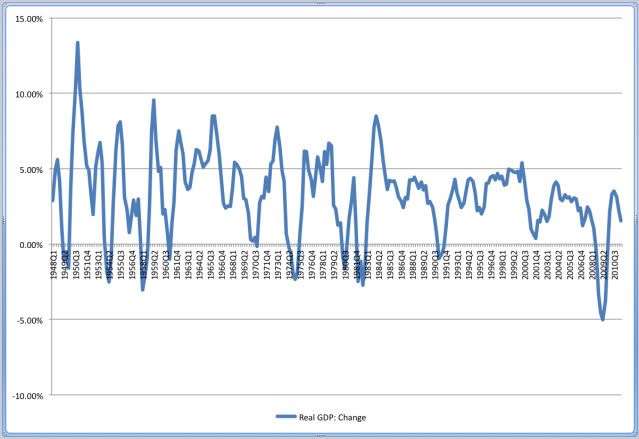
Methodologically, I began by calculating the percentage change in real GDP for each rolling four-quarter period in the quarterly data series, which ranges between 1947's first quarter (1947Q1) and 2011's second quarter (2011Q2). Naturally, the 1947 data constitute the baseline. Below is a chart with an overview of the results of these calculations:

Real GDP: Percentage Change During Rolling
Four-Quarter (4Q) Periods, 1948Q1-2011Q2


Source: Risky Business Analysis and Chart Based on BEA Data

Basically, there are 254 data points in the series. The median value is 3.18%, the mean value is 3.25%, and the standard deviation is 2.76%.

Employing the most recently recorded value of 1.55% as my dividing line, I found 197 data points are higher and 56 data points are lower.

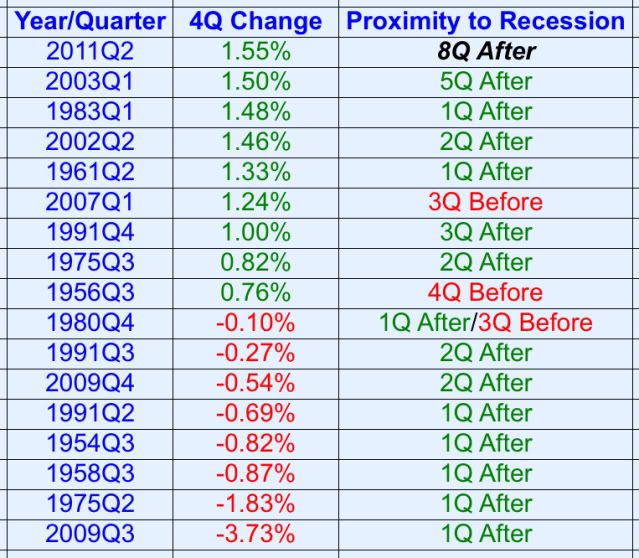
For the purpose of this study, I was uninterested in the comparatively high 197 values, but I was interested in the relatively low 56 values, which I examined in terms of their proximity to U.S. economic contractions as determined by the National Bureau of Economic Research's Business Cycle Dating Committee.

I found 40 of them were registered during recessions and 16 of them were registered within five quarters of recessions (i.e., either before or after contractions). Both the latter group of data points and the most recently recorded value of 1.55% are shown in the following table:

Real GDP: Percentage Change Over Rolling
4Q Periods and Proximity to Recession, 17 Quarters


Source: Risky Business Analysis and Table Based on BEA Data

Based not only on the data I have examined in this table in particular but also on the data I have examined in this study in general -- as well as other sources, such as the proprietary U.S. Economic Index (USEI) discussed in "You Got to Know When to Hold 'em" -- I am convinced the most recently recorded value of 1.55% is more likely to be associated with the next recession than it is to be associated with the last recession.

Could my conviction be misplaced? Sure. For example, I remember well the 2004 New York Yankees, unique in the annals of Major League Baseball as the only team to lose a seven-game playoff series subsequent to taking a 3-0 lead in the same series (i.e., there are no sure things -- not in baseball, not in the economy, not in the financial markets, and not in life).

Saturday, September 17, 2011

The R-Word and the Legion of Doom

While I continue to work on the Risky Business blog post about the current status of the U.S. economic cycle that I mentioned in "Synchronicity in the Blogosphere" yesterday, I came across "The R-Word Index: Up Means Down -- The Economist's Gauge of Gloom" today.

According to its anonymous author, "The Economist's informal R-word index tracks the number of newspaper articles [in either the Financial Times or The Wall Street Journal] that use the word 'recession' in a quarter."

Speaking of the index, he or she notes, "[I]t boasts a decent record: previous incarnations of the index pinpointed the start of American recessions in 1990 and 2007." And that, of course, makes the index's visible rise this month all the more alarming.

In a comment that could have been accurately aimed at your humble correspondent, the writer then cleverly concludes, "[T]he hacks are getting anxious."