In "GDP Slide Signals Recession. Soon." on Sunday, I indicated my fact-based opinion is that the U.S. economy either has shifted or is shifting to contraction from expansion.
One key factor in the forming of this opinion is the anemic 1.55% change in real gross domestic product (GDP) recorded during the most recently reported four-quarter period (i.e., between the third quarter of last year and the second quarter of this year.).
Support for this notion can be found in Forecasting Recessions Using Stall Speeds, a Federal Reserve Board staff working paper authored by Jeremy J. Nalewaik that was published last April 14.
According to Nalewaik: "This paper presents evidence that the economic stall speed concept has some empirical content, and can be moderately useful in forecasting recessions. Specifically, output tends to transition to a slow-growth phase at the end of expansions before falling into a recession."
Of course, the Washington-based economist adds, "[M]odels using output growth alone produce a considerable number of false positive recession signals, [so] adding the slope of the yield curve, the percent change in housing starts, and the change in the unemployment rate to the model reduces false positives and improves recession forecasting."
Meanwhile, Nalewaik contends, "GDI [gross domestic income] provides a better measure of output growth than GDP, its better-known counterpart, and in our work here, while stall phases are evident in GDP, they are more plainly visible in GDI."
Harrumph.
Showing posts with label Expansion. Show all posts
Showing posts with label Expansion. Show all posts
Tuesday, September 20, 2011

Sunday, September 18, 2011
GDP Slide Signals Recession. Soon.
If the U.S. economy has not already moved to contraction from expansion, then I believe there is a high probability it will make the transition by the close of the first half of next year.
Moreover, I think there is an intermediate probability this event will be a fait accompli by the end of the second half of this year.
One reason I reached these conclusions centers on my recent historical statistical study of the real gross domestic product (GDP) data series publicly available on the Department of Commerce's Bureau of Economic Analysis (BEA) Web site.
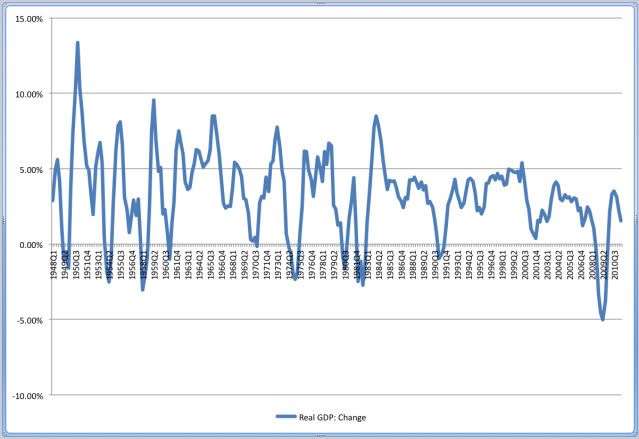
Methodologically, I began by calculating the percentage change in real GDP for each rolling four-quarter period in the quarterly data series, which ranges between 1947's first quarter (1947Q1) and 2011's second quarter (2011Q2). Naturally, the 1947 data constitute the baseline. Below is a chart with an overview of the results of these calculations:
Real GDP: Percentage Change During Rolling
Four-Quarter (4Q) Periods, 1948Q1-2011Q2

Source: Risky Business Analysis and Chart Based on BEA Data
Basically, there are 254 data points in the series. The median value is 3.18%, the mean value is 3.25%, and the standard deviation is 2.76%.
Employing the most recently recorded value of 1.55% as my dividing line, I found 197 data points are higher and 56 data points are lower.
For the purpose of this study, I was uninterested in the comparatively high 197 values, but I was interested in the relatively low 56 values, which I examined in terms of their proximity to U.S. economic contractions as determined by the National Bureau of Economic Research's Business Cycle Dating Committee.
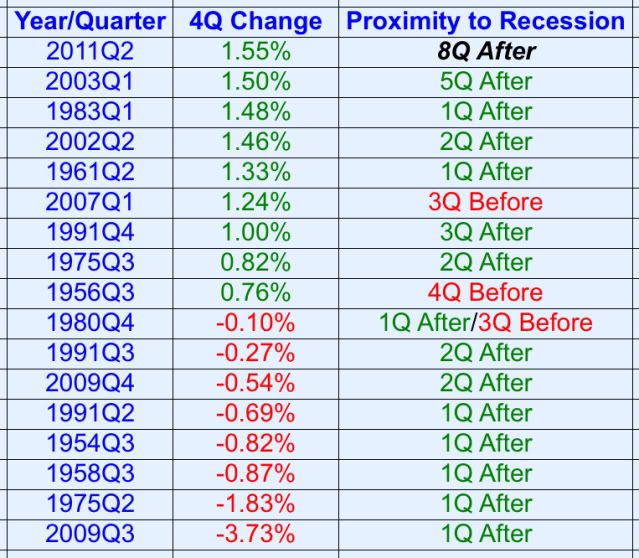
I found 40 of them were registered during recessions and 16 of them were registered within five quarters of recessions (i.e., either before or after contractions). Both the latter group of data points and the most recently recorded value of 1.55% are shown in the following table:
Real GDP: Percentage Change Over Rolling
4Q Periods and Proximity to Recession, 17 Quarters

Source: Risky Business Analysis and Table Based on BEA Data
Based not only on the data I have examined in this table in particular but also on the data I have examined in this study in general -- as well as other sources, such as the proprietary U.S. Economic Index (USEI) discussed in "You Got to Know When to Hold 'em" -- I am convinced the most recently recorded value of 1.55% is more likely to be associated with the next recession than it is to be associated with the last recession.
Could my conviction be misplaced? Sure. For example, I remember well the 2004 New York Yankees, unique in the annals of Major League Baseball as the only team to lose a seven-game playoff series subsequent to taking a 3-0 lead in the same series (i.e., there are no sure things -- not in baseball, not in the economy, not in the financial markets, and not in life).
Moreover, I think there is an intermediate probability this event will be a fait accompli by the end of the second half of this year.
One reason I reached these conclusions centers on my recent historical statistical study of the real gross domestic product (GDP) data series publicly available on the Department of Commerce's Bureau of Economic Analysis (BEA) Web site.
Methodologically, I began by calculating the percentage change in real GDP for each rolling four-quarter period in the quarterly data series, which ranges between 1947's first quarter (1947Q1) and 2011's second quarter (2011Q2). Naturally, the 1947 data constitute the baseline. Below is a chart with an overview of the results of these calculations:
Real GDP: Percentage Change During Rolling
Four-Quarter (4Q) Periods, 1948Q1-2011Q2
Source: Risky Business Analysis and Chart Based on BEA Data
Basically, there are 254 data points in the series. The median value is 3.18%, the mean value is 3.25%, and the standard deviation is 2.76%.
Employing the most recently recorded value of 1.55% as my dividing line, I found 197 data points are higher and 56 data points are lower.
For the purpose of this study, I was uninterested in the comparatively high 197 values, but I was interested in the relatively low 56 values, which I examined in terms of their proximity to U.S. economic contractions as determined by the National Bureau of Economic Research's Business Cycle Dating Committee.
I found 40 of them were registered during recessions and 16 of them were registered within five quarters of recessions (i.e., either before or after contractions). Both the latter group of data points and the most recently recorded value of 1.55% are shown in the following table:
Real GDP: Percentage Change Over Rolling
4Q Periods and Proximity to Recession, 17 Quarters
Source: Risky Business Analysis and Table Based on BEA Data
Based not only on the data I have examined in this table in particular but also on the data I have examined in this study in general -- as well as other sources, such as the proprietary U.S. Economic Index (USEI) discussed in "You Got to Know When to Hold 'em" -- I am convinced the most recently recorded value of 1.55% is more likely to be associated with the next recession than it is to be associated with the last recession.
Could my conviction be misplaced? Sure. For example, I remember well the 2004 New York Yankees, unique in the annals of Major League Baseball as the only team to lose a seven-game playoff series subsequent to taking a 3-0 lead in the same series (i.e., there are no sure things -- not in baseball, not in the economy, not in the financial markets, and not in life).
Saturday, September 17, 2011
The R-Word and the Legion of Doom
While I continue to work on the Risky Business blog post about the current status of the U.S. economic cycle that I mentioned in "Synchronicity in the Blogosphere" yesterday, I came across "The R-Word Index: Up Means Down -- The Economist's Gauge of Gloom" today.
According to its anonymous author, "The Economist's informal R-word index tracks the number of newspaper articles [in either the Financial Times or The Wall Street Journal] that use the word 'recession' in a quarter."
Speaking of the index, he or she notes, "[I]t boasts a decent record: previous incarnations of the index pinpointed the start of American recessions in 1990 and 2007." And that, of course, makes the index's visible rise this month all the more alarming.
In a comment that could have been accurately aimed at your humble correspondent, the writer then cleverly concludes, "[T]he hacks are getting anxious."
According to its anonymous author, "The Economist's informal R-word index tracks the number of newspaper articles [in either the Financial Times or The Wall Street Journal] that use the word 'recession' in a quarter."
Speaking of the index, he or she notes, "[I]t boasts a decent record: previous incarnations of the index pinpointed the start of American recessions in 1990 and 2007." And that, of course, makes the index's visible rise this month all the more alarming.
In a comment that could have been accurately aimed at your humble correspondent, the writer then cleverly concludes, "[T]he hacks are getting anxious."
Friday, September 16, 2011
Synchronicity in the Blogosphere
The "10 Friday AM Reads" (authored by Barry Ritholtz) at The Big Picture blog today leads with a link to "Do Equity Price Drops Foreshadow Recessions?" (penned by John C. Bluedorn, Jörg Decressin, and Marco E. Terronesat) at the Vox blog.
Meanwhile, a currently untitled piece (written by me) at the Risky Business blog that also centers on the U.S. economy's next move to contraction from expansion is in the preparation stage, with a tentative publication date of Sunday. (In my case, however, all the foreshadowing will be done by the real gross domestic product).
Synchronicity in the blogosphere: Gotta love it!
Meanwhile, a currently untitled piece (written by me) at the Risky Business blog that also centers on the U.S. economy's next move to contraction from expansion is in the preparation stage, with a tentative publication date of Sunday. (In my case, however, all the foreshadowing will be done by the real gross domestic product).
Synchronicity in the blogosphere: Gotta love it!
Subscribe to:
Posts (Atom)