Showing posts with label Federal Open Market Committee. Show all posts

Monday, August 25, 2014

Risky Business Monitor: Aug. 25, 2014


Fedspeak is reverberating in my mind at this moment with Federal Reserve Chair Janet L. Yellen delivering a major speech at the Federal Reserve Bank of Kansas City Economic Symposium in Jackson Hole, Wyo., Friday and the Federal Open Market Committee releasing the minutes of its July 29-30 meeting Wednesday.

An interesting article on aspects of this Fedspeak appeared in the International Business Times Sunday. However, it was authored not by me but by Reuters: “Fed Should Lay Groundwork For Interest Rate Hikes: Officials.” Meanwhile, I anticipate publishing at least one piece on the U.S. economy-market relationship this week.

Related Reading


Shameless Self-Promotion! If you like my work, then you can follow me as J.J. McGrath at Google+ and Seeking Alpha, as JJMcGrath at StockTwits and @JJMcGrath3000 at Twitter. If you do not like my work, then you can follow me at all those places, anyway.

Thursday, September 22, 2011

'Operation Twist I' and SPX Behavior

A half-century ago, the U.S. Department of the Treasury and Federal Reserve conducted "Operation Twist I" under economic conditions described well by Titan Alon and Eric Swanson last April 25 in their "Operation Twist and the Effect of Large-Scale Asset Purchases," which I mentioned in "Go, Chubby, Go: Let's Twist Again!" this week.

Yesterday, the Federal Open Market Committee (FOMC) announced "Operation Twist II" under economic conditions described well in an many places virtually every day, including this very blog (e.g., "GDP Slide Signals Recession. Soon.").

There are similarities and differences in the U.S. economic conditions existing during the two periods. One obvious similarity centers on the status of the business cycle, meaning the above-referenced R-word was or is on almost everybody's lips in both cases. One obvious difference centers on the country's debt as a percentage of gross domestic product, which was not too bad in 1961 but is not too good in 2011.

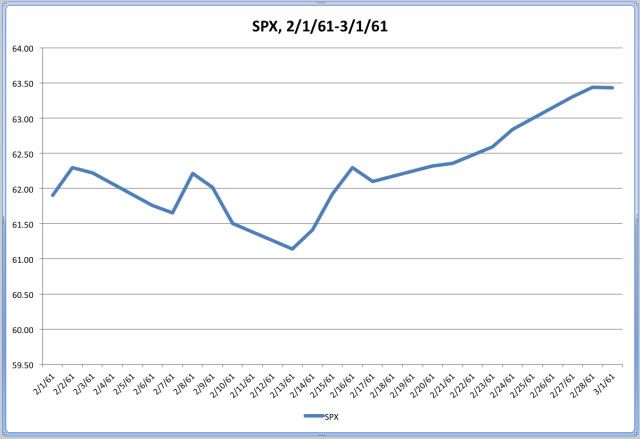
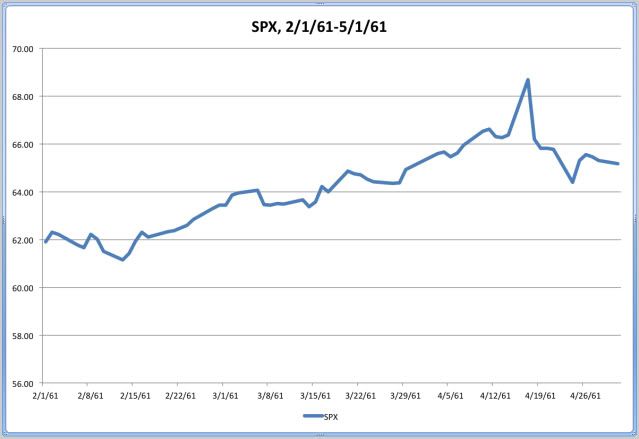
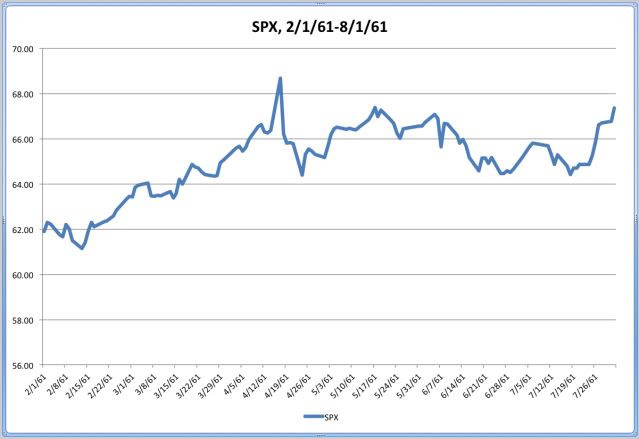
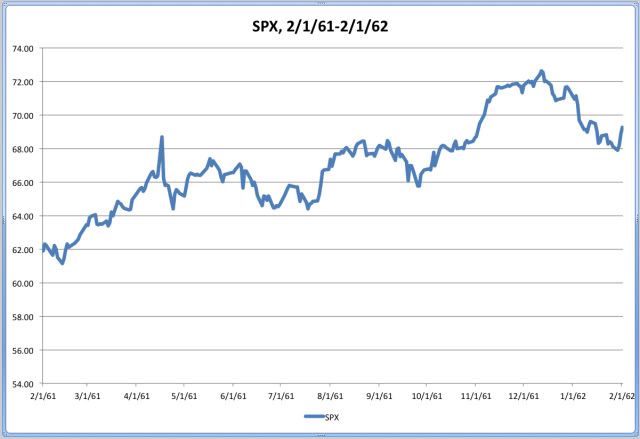
Given this mishmash, it may or may not be helpful to examine the market performance of the Standard & Poor's (S&P) 500 (SPX) in the wake of the launch of "Operation Twist I" on Feb. 2, 1961. But I did it, anyway.

With a common baseline of Feb. 1, 1961, the four charts below show the S&P 500's behavior during the following one-month, three-month, six-month, and one-year periods, respectively:


Source: Risky Business Charts Based on Yahoo! Finance Adjusted Closing-Price Data

If past is prologue, then the recent equity-market crash may be comparatively short-lived. After all, the Fed will be driving financial-market participants out of the long end and into the short end of the U.S. Treasury yield curve, as well as higher-risk assets.

If past is not prologue, then the recent stock-market crash may be relatively long-lived. Clearly, aggregate demand is lacking in the U.S., and nearly all available evidence indicates this circumstance is other than either a local or a temporary phenomenon.

You pays your money, and you takes your chances.

Wednesday, September 21, 2011

'Twist' Tops the Ops at the FOMC

In a well-choreographed move, the Federal Open Market Committee (FOMC) OK'd today by a 7-3 vote a new cover of "Operation Twist." The original version was discussed in "Go, Chubby, Go: Let's Twist Again!" on Monday.

According to the FOMC statement belatedly released at the conclusion of its two-day meeting: "[T]he committee decided today to extend the average maturity of its holdings of securities. The committee intends to purchase, by the end of June 2012, $400 billion of Treasury securities with remaining maturities of [six] years to 30 years and to sell an equal amount of Treasury securities with remaining maturities of [three] years or less. This program should put downward pressure on longer-term interest rates and help make broader financial conditions more accommodative. The committee will regularly review the size and composition of its securities holdings and is prepared to adjust those holdings as appropriate."

The FOMC also noted: "To help support conditions in mortgage markets, the committee will now reinvest principal payments from its holdings of agency debt and agency mortgage-backed securities in agency mortgage-backed securities. In addition, the committee will maintain its existing policy of rolling over maturing Treasury securities at auction."

All things considered, I believe this plan may have a limited effect on the U.S. economy, but I think its potential impact on the yield curve may constitute a headwind in terms of the profitability of certain financial institutions (e.g., banks).

Monday, September 19, 2011

Go, Chubby, Go: Let's Twist Again!

With the Federal Open Market Committee (FOMC) attempting to save the U.S. economy from itself once again at a two-day meeting this week, it appears a new cover of "Operation Twist" may be atop the playlist of at least some of the committee's members.

The Federal Reserve conducted the original Operation Twist a half-century ago under circumstances Titan Alon and Eric Swanson describe well in their "Operation Twist and the Effect of Large-Scale Asset Purchases," which appeared in the FRBSF [Federal Reserve Bank of San Francisco] Economic Letter last April 25:

"John F. Kennedy was elected president in November 1960 and inaugurated on January 20, 1961. The U.S. economy had been in recession for several months, so the incoming Administration and the Federal Reserve wanted to lower interest rates to stimulate the weak economy.

"However, Europe was not in a recession at the time and European interest rates were higher than those in the United States. Under the Bretton Woods fixed exchange rate system then in effect, this interest rate differential led cross-currency arbitrageurs to convert U.S. dollars to gold and invest the proceeds in higher-yielding European assets. The result was an outflow of gold from the United States to Europe amounting to several billion dollars per year, a very large quantity that was a source of extreme concern to the Administration and the Federal Reserve.

"The Kennedy Administration’s proposed solution to this dilemma was to try to lower longer-term interest rates while keeping short-term interest rates unchanged -- an initiative now known as 'Operation Twist' in homage to the dance craze then sweeping the nation.

"The idea was that business investment and housing demand were primarily determined by longer-term interest rates, while cross-currency arbitrage was primarily determined by short-term interest rate differentials across countries. Policymakers reasoned that, if longer-term interest rates could be lowered without affecting short-term yields, the weak U.S. economy could be stimulated without worsening the outflow of gold."


Hmm. In the anticipated remake of Operation Twist, the Fed is expected to first sell shorter-term U.S. Treasury securities already on its books and then employ the proceeds to buy longer-term U.S. Treasury securities, with little or no effect on the bottom line of its overall balance sheet. Meanwhile, the cross-border flow of gold seems to be a nonissue this time around, given President Richard Nixon's closing of the gold window in 1971, which ended the convertibility between the precious metal and U.S. dollars. Hmm.

In the words of one of my favorite financial-market observers after the FOMC's announcement last Nov. 3 that it would be monetizing an additional $600 billion in U.S. debt by purchasing an assortment of U.S. Treasury securities, "I believe this plan may have a limited impact on the U.S. economy."

Because of the inviolable Risky Business Law of Unintended Consequences, however, this apparent new program could boost prices in certain financial-asset classes, such as commodities. (As I once noted elsewhere, one effect of this unbreakable law appears to be that every time I slip-'n'-slide my way into the shower of the RB Executive Washroom, the telephone rings. Given my unique blend of astigmatism and myopia, this could one day lead to a pretty humorous obituary.)

Operation Twist: Those oldies but goodies remind me of you* . . .


*Props to Little Caesar & the Romans